
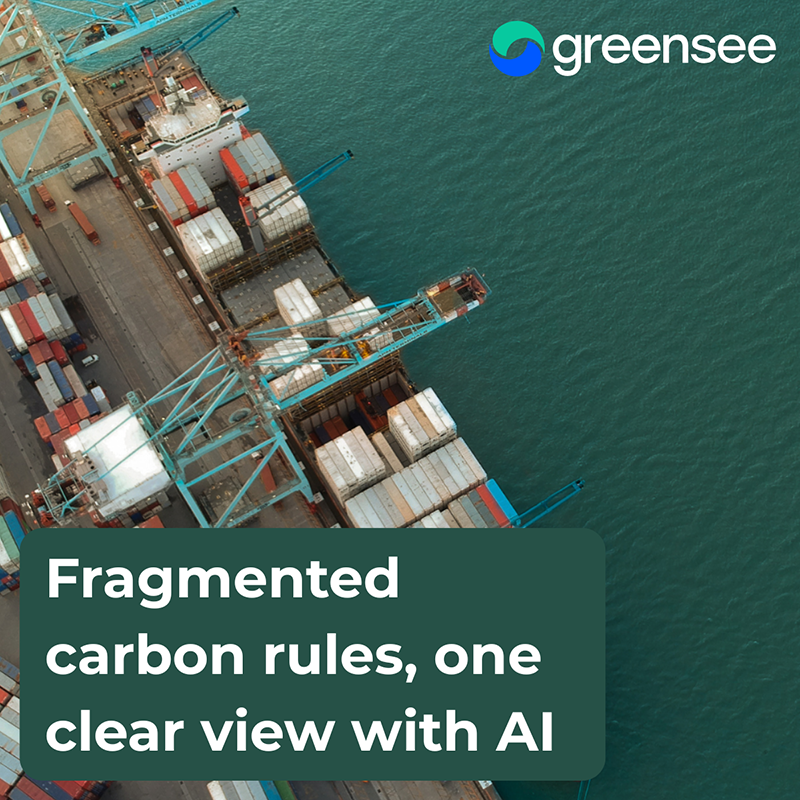
Global rules for shipping decarbonisation are moving slower than the politics around them. While the IMO’s long-term net-zero pathway is still being shaped, regional and national regulators are already building their own carbon-pricing systems. The EU ETS now covers maritime emissions, FuelEU Maritime is tightening fuel-intensity rules, and the UK ETS is preparing to bring domestic maritime into scope from 2026.
For shippers, carriers, freight forwarders and terminals, this means one thing. Instead of a single global framework, CO₂ regulation is turning into a patchwork. A single shipment can pass through several schemes, each with its own scope, calculation method, reporting format and penalties. Trying to keep up with this using static spreadsheets or one-off carbon calculators increases the risk of paying too much, paying twice or falling out of compliance altogether.
At the same time, customers are asking harder questions. They want lane-level CO₂ data, credible Scope 3 reporting and clear logic for any carbon surcharges. Commercial teams cannot answer those questions reliably if every department is using a different emissions factor or a different view of the voyage. This is no longer just a regulation issue. It is a data and coordination challenge across the entire logistics chain.
Greensee AI is built to close this gap. Our platform turns raw operational data into a single CO₂ intelligence layer that covers ocean, port and inland legs. Voyage tracks, fuel consumption, reefer energy use, terminal moves and inland transport can all feed into one neutral emissions model. On top of this, Greensee applies the logic of different regimes such as EU ETS, FuelEU Maritime and the emerging UK ETS, so you can see how each rule affects cost and compliance on every service loop.
Because Greensee aligns with frameworks such as Smart Freight Centre and ISO 14083, the same CO₂ dataset can support regulatory reporting, customer disclosures and internal targets. Shippers can compare corridors and allocate demand to lower-carbon options. Carriers can quantify carbon cost per voyage, per TEU and per customer contract. LSPs can build consistent Scope 3 views across different carriers. Terminals can connect energy and equipment data back into the full journey. Everyone works from the same emissions truth.
Looking ahead
CO₂ regulation for shipping will stay complex. New schemes in regions like the UK and other coastal markets will add extra layers rather than simplify the picture. Companies that try to rebuild their tools for every new rule will always be reacting from behind. Companies that adopt an AI-led approach can treat regulation as a set of evolving parameters on top of a stable CO₂ data foundation.
Greensee AI is designed for that second group. As new carbon schemes and reporting rules appear, our models integrate them into the same intelligence layer, so your teams can focus on decisions instead of decoding regulation. Whether you are planning new low-carbon services, renewing tenders or preparing for audits, you get one consistent view of emissions, cost and risk across your network.
The regulatory landscape for shipping is becoming more fragmented. Your CO₂ strategy does not need to follow the same path. With Greensee AI, shippers, carriers, LSPs and terminals can prepare for complex CO₂ regulation, protect margin and build decarbonisation plans that stand up to customer and regulator scrutiny.