
Applying Simulation Across Millions of Reefer Data Points to Improve Temperature Control, Energy Efficiency, and Emissions
World models are increasingly discussed as the next step in AI. In simple terms, they describe systems that learn how real-world operations behave over time and predict how those systems respond to change.
At a practical level, a world model takes the current state of a system, applies an intervention, and estimates the resulting outcome.
This moves AI from analysing what has already happened to evaluating what is likely to happen next.
From Historical Analysis to Forward-Looking Models
Most AI systems in operations today are retrospective. They process historical data to identify patterns, flag anomalies, or generate reports.
This approach has clear limitations in physical systems where conditions change continuously.
World model-based systems address this by estimating how a system evolves and how it responds to operational decisions. This allows operators to:
- Anticipate system behaviour under changing conditions
- Assess the impact of decisions before execution
- Prioritise actions based on expected outcomes
This is particularly relevant in environments with continuous sensor data, multiple interacting variables, and non-linear behaviour.
Cold Chain as a Dynamic System
Cold chain logistics is a dynamic system with tightly linked variables.
Temperature inside a reefer container is influenced by:
- internal settings such as setpoint and return air temperature
- external conditions, including ambient temperature and geography
- energy inputs, including power availability and source
- operational factors such as routing, dwell time, and handling
- asset characteristics such as model, age, and efficiency
Changes in any one of these variables affect the system over time. Decisions made at one stage of a journey can have delayed and compounding effects.
This is precisely the type of environment where forward-looking system models are required.
Greensee’s Approach: Thermal Twins at Scale
Greensee applies this approach through thermal twins.
These models combine:
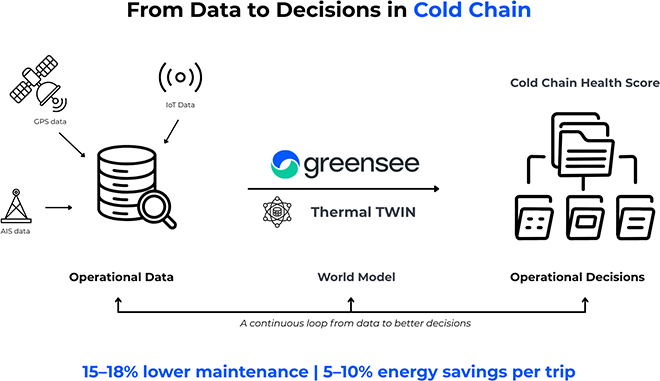
- continuous telemetry from reefer units
- energy consumption data across the genset and grid usage
- environmental and route-level context
- asset-specific performance characteristics
The result is a structured representation of how temperature, energy consumption, and emissions evolve across a trip.
This is built on millions of trip-level data points and billions of sensor observations, providing a robust foundation for prediction across varying operating conditions.
From Prediction to Operational Decisions
The system produces outputs such as:
- temperature deviation and breach risk
- energy consumption patterns
- CO₂ emissions at asset and trip level
- performance differences across equipment and routes
These outputs reflect how the system is expected to behave under current conditions.
The next step is to evaluate how different actions change those outcomes. This includes both operational decisions and maintenance strategies.
Examples include:
- Adjusting temperature setpoints to reduce breach risk
- Switching power sources to manage energy use and emissions
- Rerouting to avoid high-risk conditions
- Prioritising repair, test, and preventive interventions (RTPI) by identifying assets showing early signs of inefficiency or failure
- Assessing the impact of repairing or replacing underperforming units on energy consumption and temperature stability
RTPI refers to the set of actions used to maintain and restore asset performance, including diagnostics, targeted repairs, and preventive servicing. When guided by predictive models, these actions can be scheduled earlier and more selectively.
Each intervention is assessed based on its expected impact on temperature control, energy consumption, and emissions.
In practice, this translates into measurable operational impact.
On average, pilot deployments show:
- 15–18% reduction in unnecessary maintenance costs, driven by more targeted RTPI
- 5–10% energy savings per trip through improved operating decisions
- A significant reduction in temperature excursions, improving cargo stability and reducing risk
These outcomes reflect the value of evaluating decisions before execution, rather than reacting after performance has degraded.
From Monitoring to Control
Most existing cold-chain platforms focus on visibility. They provide information on what has happened.
A system built on forward-looking models supports a different mode of operation. It allows operators to:
- Identify risks before they materialise
- Compare alternative decisions
- Optimise outcomes across cost, service level, and emissions
This represents a shift from monitoring systems to decision-support systems.
Conclusion
World models are often presented as a future development in AI. In cold chain logistics, the underlying approach is already being applied in practice.
Thermal twins and related models provide a structured way to represent system behaviour and evaluate the impact of decisions before they are taken.
The implication is direct. The value of AI in logistics extends beyond visibility. It lies in improving decisions by estimating their consequences in advance.
Next Steps
Explore how Greensee RISE applies these capabilities to improve operational performance across cold chain networks:
https://greensee.ai/rise/
For a more detailed discussion on how this approach can be applied to your operations, contact the Greensee team.