
A structured overview of where AI delivers measurable value in freight operations, and how emissions regulation is reshaping technology selection.
1. Introduction
Artificial intelligence has moved from pilot programmes to production deployment across the logistics sector. Adoption is no longer confined to large carriers and global forwarders: approximately 45% of supply chain companies now apply AI to forecasting, route planning, or real-time visibility.[2] At the same time, the term “AI in logistics” covers a set of technologies with materially different functions, data requirements, and returns.
This paper provides a structured overview of the principal applications of AI in logistics, examines the regulatory developments accelerating adoption — among them ISO 14083, the EU Corporate Sustainability Reporting Directive (CSRD), the extension of the EU Emissions Trading System to shipping, and FuelEU Maritime — and outlines the considerations relevant to shippers, logistics service providers, carriers, and terminal operators evaluating these technologies. It concludes with a description of how the Greensee platform addresses each application domain.
2. Market Context
The commercial momentum behind AI in logistics is well documented. The global market is projected to grow from approximately USD 12.2 billion in 2026 to USD 196.6 billion by 2034, a compound annual growth rate of 41.5%.[1] Within individual functions, the results driving this investment are equally clear: 87% of enterprises now apply AI to demand forecasting, reporting accuracy improvements above 35%, and optimised routing has been shown to reduce transport emissions by up to 30% on selected lanes.[3]
Two factors distinguish the current adoption cycle from earlier waves of logistics technology. First, the underlying data — AIS vessel positions, telematics, IoT sensor feeds, terminal event streams — is now broadly available and machine-readable. Second, regulatory reporting obligations have converted capabilities that were previously discretionary, notably emissions measurement, into requirements.
3. Four Application Domains
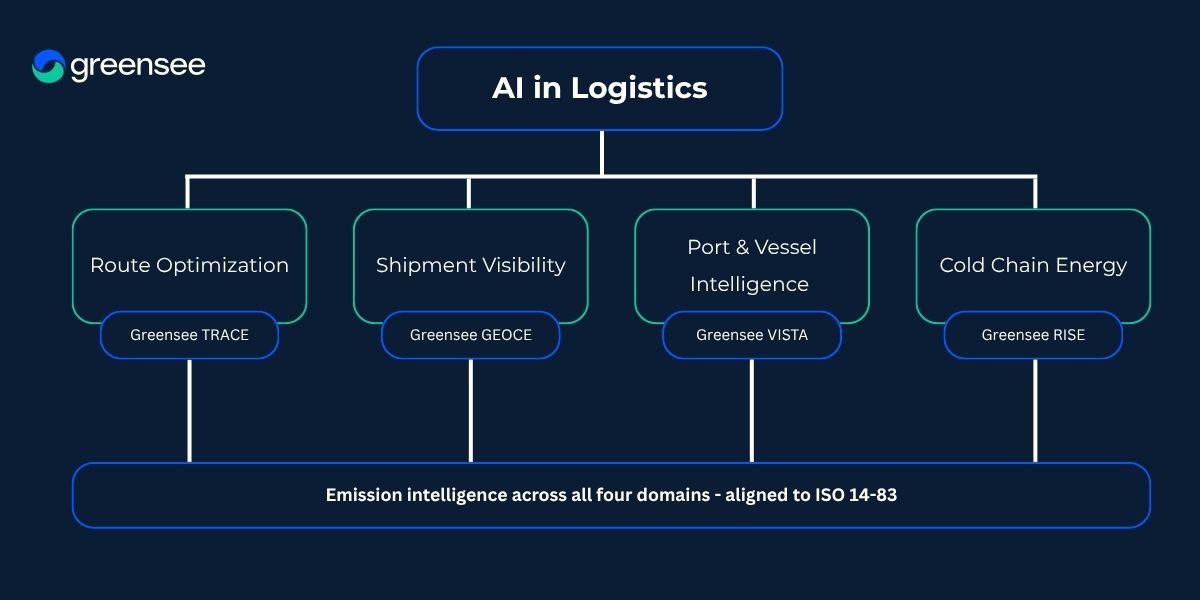
AI applications in logistics can be grouped into four operational domains, each addressing a distinct cost driver. Figure 1 summarises the landscape and indicates the corresponding module within the Greensee platform.
3.1 Route and Network Optimisation
Optimisation models evaluate large numbers of feasible routings across ocean, rail, and road, balancing transit time, cost, congestion risk, and carbon intensity. As emissions enter tender criteria, route selection increasingly requires that cost and CO₂ be optimised jointly rather than sequentially. Operators applying AI-based routing report savings in both fuel expenditure and emissions on the affected lanes.
3.2 Shipment Visibility and Asset Tracking
Conventional track-and-trace systems record historical positions. AI-based visibility platforms extend this with predictive capability: estimated times of arrival that account for port congestion and vessel behaviour, and exception alerts generated early enough to permit operational response. The value of visibility is realised not in the tracking itself but in the decisions it enables — re-booking, re-routing, and proactive customer notification.
3.3 Port and Vessel Intelligence
Berth waiting time, vessel turnaround, and anchorage queues represent a significant and historically unmeasured source of cost and emissions. Models built on AIS and terminal data now allow ports, carriers, and shippers to benchmark terminal performance, quantify idle time, and incorporate congestion patterns into scheduling and commercial negotiations.
3.4 Cold Chain Energy Management
Refrigerated containers are among the most energy-intensive assets in the supply chain. AI-based reefer management analyses the interaction of cargo type, temperature setpoint, and ambient conditions to reduce energy consumption while maintaining cargo integrity. For reefer fleet operators, this domain typically offers the shortest payback period of the four.
4. The Regulatory Drivers: ISO 14083, CSRD, EU ETS, and FuelEU Maritime
ISO 14083:2023 establishes the international methodology for quantifying greenhouse gas emissions arising from transport chain operations. It has become the reference standard for freight emissions calculation and underpins reporting under the EU Corporate Sustainability Reporting Directive, which requires large companies operating in the EU to disclose Scope 3 emissions — including purchased transport — with audit-grade rigour. Further detail on the applicable frameworks is available on our Regulations & Compliance page.
Reporting standards are, however, only one part of the regulatory landscape. Carbon pricing now applies directly to freight. The EU Emissions Trading System (EU ETS) has been extended to maritime transport, requiring shipping companies to surrender allowances against voyage emissions, and FuelEU Maritime imposes progressively tightening limits on the greenhouse gas intensity of marine fuels. At the global level, the IMO’s net-zero framework sets a trajectory towards net-zero emissions from international shipping by or around 2050, with a global fuel-intensity regulation expected to follow. Comparable schemes, including the UK ETS, are extending the same logic to other jurisdictions. Collectively, these instruments convert emissions performance from a reporting obligation into a direct operating cost — one that can be measured, traded, and reduced.
The practical consequence is that emissions data requirements now cascade through the supply chain. Shippers subject to CSRD request shipment-level emissions figures from their logistics providers; those providers, in turn, require standards-based calculation from their carriers and technology platforms. Emissions measurement has therefore shifted from a sustainability initiative to a commercial qualification, appearing with increasing frequency in requests for quotation.
This development has an architectural implication. Because every routing, scheduling, and energy decision carries a carbon consequence, emissions calculation is most reliable — and least costly — when performed natively within the operational platform, rather than reconstructed afterwards from fragmented records.
5. The Greensee Platform
Greensee is a modular AI platform structured around the four application domains described above. TRACE provides route and network optimisation with joint cost and CO₂ objectives; GEOCE delivers real-time geospatial shipment and asset tracking; VISTA provides vessel visibility and port performance analytics; and RISE manages reefer energy consumption. All four modules operate on a shared data foundation with an emissions intelligence layer aligned to ISO 14083.
The platform is designed for integration rather than replacement: modules connect to existing TMS, ERP, and terminal systems through a REST API ecosystem, and clients adopt only the modules relevant to their operations. Deployments include SeaCube, which applies RISE to reduce reefer energy costs across its fleet, and Prometheus, the North American logistics technology provider, which integrates Greensee’s Scope 3 emissions tracking and route monitoring into its multimodal platform.
Beyond its modules, Greensee operates PACEX, a joint venture with Climate Change Ventures headquartered in Hong Kong. PACEX (Platform for Accounting and Carbon Exchange) extends the platform’s emissions intelligence into maritime carbon markets, combining sector-focused emissions trading, regulator-ready emissions accounting verified under the GLEC framework, and green transition finance for shipowners and operators across the Asia-Pacific region.
6. Considerations for Operators
Three considerations consistently distinguish successful AI deployments from stalled initiatives. The first is scope: programmes anchored to a single, measurable operational problem — an underperforming lane, a rising reefer energy bill, excessive anchorage time at a specific terminal — produce evidence quickly and scale on the basis of results. The second is integration: solutions should deliver intelligence into the systems and workflows already in use, rather than introducing parallel tooling. The third is emissions readiness: given the trajectory of ISO 14083 and CSRD requirements, platforms that treat carbon as a native metric avoid the substantially higher cost of retrofitting compliance at a later stage.
Evaluated against these criteria, a quarterly pilot with defined baseline metrics remains the most reliable procurement approach. Where results are positive, modular architectures allow expansion without re-platforming.
7. Outlook: World Models and Simulation-Based AI
A further development merits attention. Much of the current generation of logistics AI is predictive: it estimates an arrival time, a congestion level, or an energy requirement from historical patterns. World models represent a different approach. Rather than predicting a single variable, a world model learns an internal representation of how an environment behaves — how congestion propagates through a port, how a delay at one terminal cascades across a network, how a reefer responds to changing ambient conditions — and uses that representation to simulate the consequences of decisions before they are taken.
For logistics, the implications are considerable. A sufficiently accurate world model of a trade lane or terminal would allow operators to test routing, scheduling, and energy decisions in simulation, comparing cost, time, and emissions outcomes before committing assets. The approach extends the logic of the digital twin from monitoring towards genuine decision rehearsal, and major AI laboratories and chipmakers are investing in it heavily.
The technology remains at an early stage, and operators should treat it as a development to monitor rather than a current procurement criterion. What can be said with confidence is that world models are data-intensive: they require precisely the granular operational record — vessel movements, terminal events, sensor feeds, shipment-level emissions — that platforms such as Greensee assemble today. Organisations building that data foundation now will be positioned to adopt simulation-based AI as it matures; those without it will not.
8. Conclusion
AI in logistics is neither a single technology nor a speculative one. It is a set of four mature application domains — routing, visibility, port intelligence, and cold chain energy — whose returns are documented and whose adoption is accelerating under regulatory pressure. The organisations best positioned for the coming reporting cycle are those that pair operational AI with standards-based emissions intelligence on a single platform.
Further information on the Greensee platform and its modules is available at greensee.ai, or through the Greensee team.
Frequently Asked Questions
What is AI in logistics?
AI in logistics is the application of machine learning, optimisation, and predictive analytics to freight operations. Its principal domains are route optimisation, shipment visibility and predictive ETAs, port and vessel performance analytics, and cold chain energy management.
How does AI reduce logistics costs and emissions?
AI reduces costs and emissions by selecting lower-cost, lower-carbon routings, predicting disruptions early enough to permit response, quantifying and reducing vessel idle time at ports, and lowering reefer energy consumption. Because fuel and energy drive both cost and CO₂, the two benefits generally move together.
What is ISO 14083 and why does it matter?
ISO 14083:2023 is the international standard for quantifying greenhouse gas emissions from transport chain operations. It underpins CSRD reporting and customer emissions disclosures, and is increasingly a qualification requirement in freight tenders.
How should an organisation begin adopting AI in logistics?
Established practice is to begin with a scoped pilot addressing one measurable problem, require integration with existing systems, and select platforms with native, standards-based emissions measurement. Modular platforms allow subsequent expansion without re-platforming.
What are world models in logistics AI?
World models are AI systems that learn an internal representation of how an environment behaves — a port, a trade lane, a reefer fleet — and use it to simulate the outcomes of decisions before they are taken. In logistics they point towards simulation-based planning, in which routing, scheduling, and energy decisions are rehearsed and compared on cost, time, and emissions before assets are committed. The approach is still maturing, and it depends on the granular operational data that current AI platforms collect.
Sources
- Fortune Business Insights, AI in Logistics Market Size, Share and Growth Forecast to 2034 (2026). ↩
- Open Sky Group, Supply Chain AI Statistics, 2026. ↩
- AllAboutAI, The AI in Supply Chain Report 2026: Market Data, Use Cases and Outlook. ↩