
From Data to Capital
How World Models, Physics AI and Open Platforms Are Transforming Industrial Assets into Financial Assets
Greensee – Q2 2026
Executive Summary
Industrial companies are entering a new era. For the last thirty years, digital transformation focused on software.
Companies invested heavily in ERP systems, asset management platforms, monitoring tools and business applications designed to digitize workflows and improve operational efficiency.
Today, a more profound transformation is underway. The combination of massive IoT deployments, open-source AI ecosystems, world models and physics-based artificial intelligence is changing the very nature of industrial value creation.
For the first time, operational performance can be measured continuously, predicted accurately and verified independently.
As a result, industrial assets are beginning to evolve into financial assets.
Heat pumps, refrigeration systems, logistics fleets, buildings, warehouses and energy infrastructure are no longer simply physical equipment.
They are becoming continuously measured, AI-modeled and financeable performance systems.
The companies that thrive in this new environment will not be those with the most software. They will be those that control their data, maintain technological independence and build AI-ready infrastructures capable of integrating future generations of physical intelligence.
The End of the Software Era
Enterprise software was designed for a world where information was scarce.
- ERP systems recorded transactions.
- Asset management platforms stored maintenance records.
- SCADA systems monitored industrial equipment.
- Business intelligence tools explained what happened yesterday.
These systems created enormous value. But they share a common limitation: they were built to manage processes rather than understand physical reality.
The next generation of industrial systems is fundamentally different.
- Rather than organizing information, they model how the world behaves.
- Rather than reporting events, they predict outcomes.
- Rather than supporting decisions, they increasingly generate them.
This transition marks the beginning of the World Model era.
The Rise of Physics-Based AI
Most AI systems deployed during the last decade focused on pattern recognition.
- Detecting anomalies.
- Classifying images.
- Forecasting demand.
- Generating text.
Physics-based AI introduces a different approach. Instead of learning only statistical correlations, these models learn or incorporate the physical laws governing real-world systems.
Examples include:
Energy Systems
Predicting:
- Heat pump efficiency
- Building thermal inertia
- Cooling demand
- Electrical consumption
- Grid interactions
Logistics
Predicting:
- Vessel fuel consumption
- Reefer energy usage
- Port congestion
- Dwell times
- Maintenance requirements
Infrastructure
Predicting:
- Equipment degradation
- Vegetation growth risks
- Grid loading
- Environmental impacts
The objective is no longer analytics. The objective is simulation.
Industrial companies increasingly move from:
“What happened?” to “What will happen?” and ultimately “What is the best action to take?”
The IoT Data Deluge
The foundation of this transformation is data. Every industrial sector is becoming sensor-rich.
- Heat pumps stream operational telemetry.
- Buildings generate continuous energy data.
- Containers report temperatures and compressor activity.
- Vehicles transmit location and operational status.
- Power networks monitor millions of endpoints.
A single industrial fleet can now generate billions of measurements annually.
Collecting data is no longer difficult. Extracting value from data has become the strategic challenge.
The organizations that successfully combine IoT telemetry with physics-based AI will create a significant competitive advantage over those relying solely on traditional software systems.
The Emergence of Performance Finance
A second and less visible revolution is now beginning.
Historically, sustainability finance relied largely on declarations, audits and periodic reporting. Investors had limited visibility into the actual physical performance of financed assets.
Physics AI changes this model completely. Continuous telemetry enables continuous verification. For the first time, lenders can finance measured performance rather than estimated performance.
This evolution creates an entirely new category of value:
Verified Operational Performance.
- Energy efficiency.
- Carbon intensity.
- Asset health.
- Operational reliability.
All become measurable, auditable and bankable. Operational data becomes a financial asset.
Case Study: Reefer Intelligence and the Creation of Finance-Grade Sustainability Assets
The refrigerated container industry provides one of the clearest examples of this transformation.
A modern reefer fleet generates millions of telemetry records every day:
- Energy consumption
- Compressor cycles
- Temperature performance
- Setpoint adherence
- GPS positions
- Maintenance events
Historically this information remained trapped inside operational systems. Its value was limited to maintenance and fleet management.
Greensee’s Reefer Intelligence platform applies thermodynamic models and AI to transform this operational data into standardized sustainability indicators. These include container-level energy intensity, emissions intensity and asset health metrics aligned with ISO 14083 methodologies.
This creates something fundamentally new.
Instead of reporting sustainability annually, fleet operators can continuously demonstrate sustainability performance.
Instead of relying on estimated fleet averages, lenders can evaluate verified asset-level performance.
This capability opens the door to:
- Sustainability Linked Loans (SLLs)
- Green Bonds
- Green Leasing Structures
- ESG-linked Debt Facilities
- Performance-Based Financing
The opportunity is substantial.
The maritime finance market already includes more than $185 billion of debt aligned with the Poseidon Principles, while sustainable lending continues to expand globally.
For large container lessors, independently verified performance indicators can support margin reductions of up to 25 basis points, representing millions of dollars in annual financing savings on billion-dollar debt facilities.
In this model, the value of IoT data is no longer operational. It becomes financial.
The same principle will increasingly apply to:
- Heat pump portfolios
- Commercial buildings
- Energy infrastructure
- Electric vehicle fleets
- Logistics networks
The future of green finance will be built on continuously verified physical performance.
Why Proprietary Platforms Become a Strategic Constraint
This transformation creates a major challenge for industrial organizations.
Most enterprise software platforms were not designed for Physics AI. They were not designed for world models. They were not designed for continuous performance finance.
Many proprietary systems create:
- Vendor lock-in
- Closed data structures
- Restricted AI integration
- Slow innovation cycles
Meanwhile, innovation increasingly occurs in open ecosystems:
- Python
- PyTorch
- DuckDB
- Ray
- Kubernetes
- Apache Arrow
- Open-source LLMs
- Open simulation frameworks
The innovation cycle of open AI ecosystems is measured in weeks. Traditional enterprise software roadmaps are measured in years.
Organizations dependent on closed software architectures risk becoming unable to integrate future generations of AI and physical intelligence.
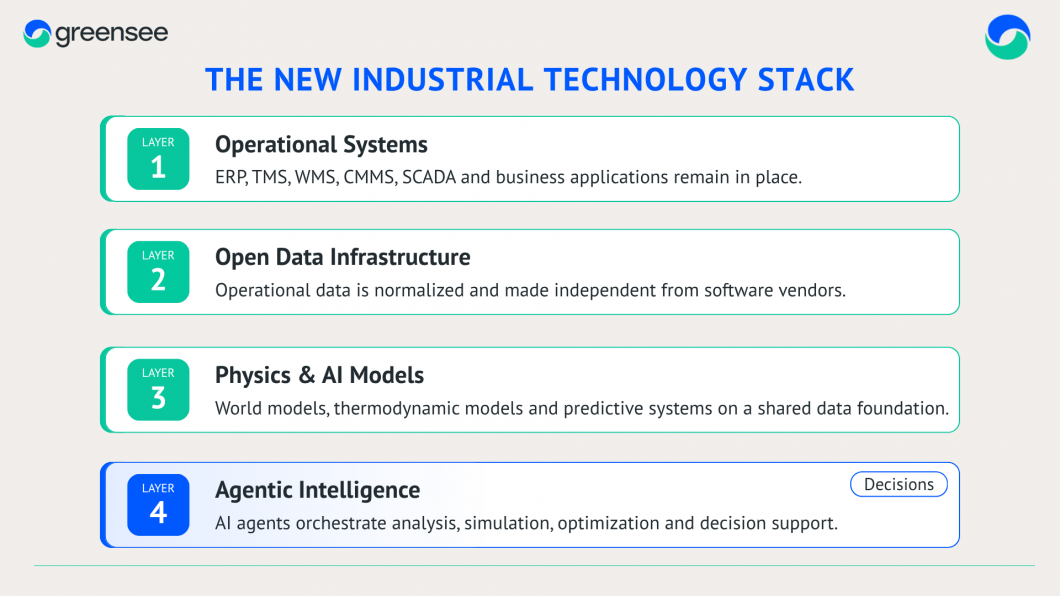
The New Industrial Technology Stack
Leading industrial organizations are converging toward a common architecture.
Layer 1 — Operational Systems
ERP, TMS, WMS, CMMS, SCADA and business applications remain in place.
Layer 2 — Open Data Infrastructure
Operational data is normalized and made independent from software vendors.
Layer 3 — Physics and AI Models
World models, thermodynamic models and predictive systems operate on a shared data foundation.
Layer 4 — Agentic Intelligence
AI agents orchestrate analysis, simulation, optimization and decision support across the organization.
This architecture maximizes innovation while preserving independence.
The Greensee Philosophy
Greensee was founded on a simple belief:
- Industrial intelligence should not be trapped inside software.
- It should emerge from data, physics and open innovation.
Our mission is therefore not to replace customer systems. Our mission is to make them AI-ready.
Across logistics, refrigeration, buildings, energy systems and infrastructure, Greensee develops open, interoperable platforms capable of integrating operational data, thermodynamic models, digital twins and future generations of AI.
We believe the most valuable industrial asset of the next decade will not be software. It will be the ability to continuously understand, predict, verify and monetize real-world performance.
In the age of World Models and Physics AI, data becomes intelligence.
Intelligence becomes performance.
And performance becomes capital.