
Within the maritime industry, the decarbonisation narrative is predominantly centred on alternative fuels. Methanol engines, LNG dual-fuel vessels, ammonia readiness and onboard carbon capture technologies are frequently presented as the primary pathways to regulatory compliance.
Operational reality, however, reveals a materially different decarbonisation trajectory.
Shipping is not yet entering a true fuel transition. Instead, the sector is entering a regulatory transition in which emissions are priced before alternative fuels are available at scale. As a result, the defining factor of this decade will not be fuel adoption, but deployable emissions reduction. At present, only one solution meets that requirement across the global fleet: energy efficiency.
The fuel transition remains constrained by availability
Ship orders increasingly include alternative fuel capability, making fleets technically ready for future fuels. Yet technical readiness does not equal operational availability.
Shipping is projected to require tens of millions of tonnes of low-GHG fuels within this decade, but realistic supply remains significantly lower and will be shared with aviation, chemicals and heavy industry. The constraint has shifted from engines to fuel production and distribution.
LNG and methanol dominate near-term adoption, but most supply remains fossil-derived under lifecycle accounting, limiting real emissions reduction. Hydrogen and ammonia face more fundamental barriers, including production capacity, storage, handling and bunkering infrastructure.
This produces a structural gap. Vessels are increasingly capable of operating on low-carbon fuels, yet operations remain dependent on conventional energy. The industry is preparing for a fuel future that infrastructure cannot yet support.
Carbon capture is not a near-term operational solution
While onboard carbon capture is frequently presented as a compliance mechanism, the concept presents significant limitations. From a technical standpoint, the technology is viable. From a systemic perspective, deployment remains incomplete.
Effective CO₂ utilisation requires discharge, transport and permanent storage capabilities. Even optimistic deployment scenarios depend on coordinated infrastructure investment across major global ports before delivering measurable emissions reductions. This necessary infrastructure ecosystem remains largely underdeveloped.
Consequently, carbon capture represents a medium-term compliance lever rather than a near-term solution. As observed in previous maritime transitions, vessel capability evolution typically outpaces supporting port infrastructure development.
Regulation has already changed investment priorities
While alternative fuel development remains uncertain, regulatory frameworks are now operational. The EU ETS is active, FuelEU Maritime compliance has commenced, and the IMO Net Zero framework approaches implementation.
These regulatory frameworks share a fundamental principle: they establish financial accountability for emissions intensity rather than prescribing specific fuel requirements.
This distinction is strategically significant. Once emissions carry a measurable financial cost, operators prioritise solutions delivering emissions reduction at the lowest operational expense. The commercially deployable solution becomes more valuable than the theoretically optimal one.
Efficiency becomes the primary decarbonisation pathway
Shipping energy efficiency measures do not depend on developing alternative fuel supply chains. Voyage optimisation, speed management, synchronised scheduling, weather routing and performance monitoring reduce fuel consumption across existing fleets without requiring propulsion system modifications or new infrastructure.
Operational and technical efficiency improvements deliver measurable emissions reductions at comparatively low cost. Their immediate scalability makes them ideally positioned to align with the current regulatory compliance environment.
In practice, the initial phase of maritime decarbonisation will function as system-wide optimisation rather than fuel substitution. Ports, terminals and vessels will operate as an integrated energy network. The industry will transition from reducing fuel consumption through alternative fuels to reducing total fuel consumption.
The decade of operational optimisation
The long-term strategic direction is clear: low-carbon and zero-carbon fuels will ultimately power deep-sea shipping. However, the required infrastructure, regulatory frameworks and production capacity will require decade-long development cycles.
Between now and that transition lies a carbon-priced operational period. During this phase, efficiency is not a bridging measure. It is the primary decarbonisation mechanism.
The maritime energy transition will ultimately depend on new fuels.
The emissions reductions of the 2020s will depend on operational decisions.
From theory to operations
When energy efficiency becomes the primary decarbonisation mechanism, the focus shifts from strategy to operational performance. The key question is no longer which fuel will be used, but where, when and how fuel is consumed across the voyage and which operational decisions influence that consumption.
Shipping emissions rarely originate from a single factor. They emerge from cumulative operational behaviour, including speed profiles, routing choices, waiting patterns, operational buffers and vessel utilisation. Without visibility into these patterns, optimisation remains assumption-driven rather than evidence-based.
Digital operational intelligence provides that visibility.
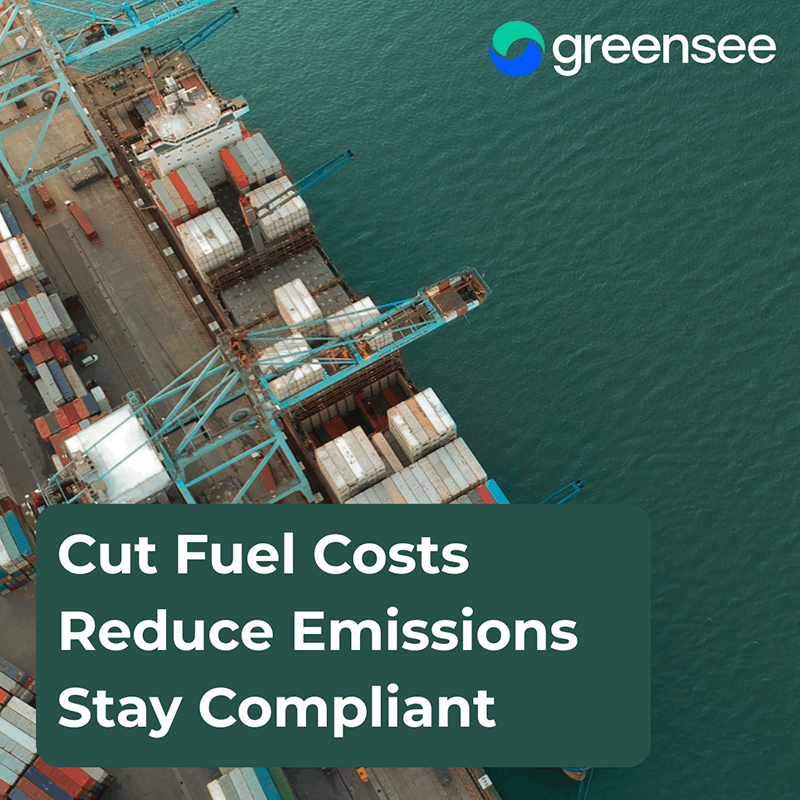
Greensee works with shipping lines to measure and optimise operational performance across fleets. By analysing real operational behaviour, operators can identify inefficiencies, quantify their impact and implement targeted improvements that reduce fuel consumption and emissions without modifying the vessel.
For shipping companies addressing EU ETS exposure, FuelEU Maritime compliance or broader decarbonisation targets, the first step is understanding operational emissions drivers. Measuring performance enables optimisation, and optimisation enables reduction.
Understand where your vessels are losing fuel and emissions margin. Contact Greensee to analyse your fleet performance and identify immediate reduction opportunities.