
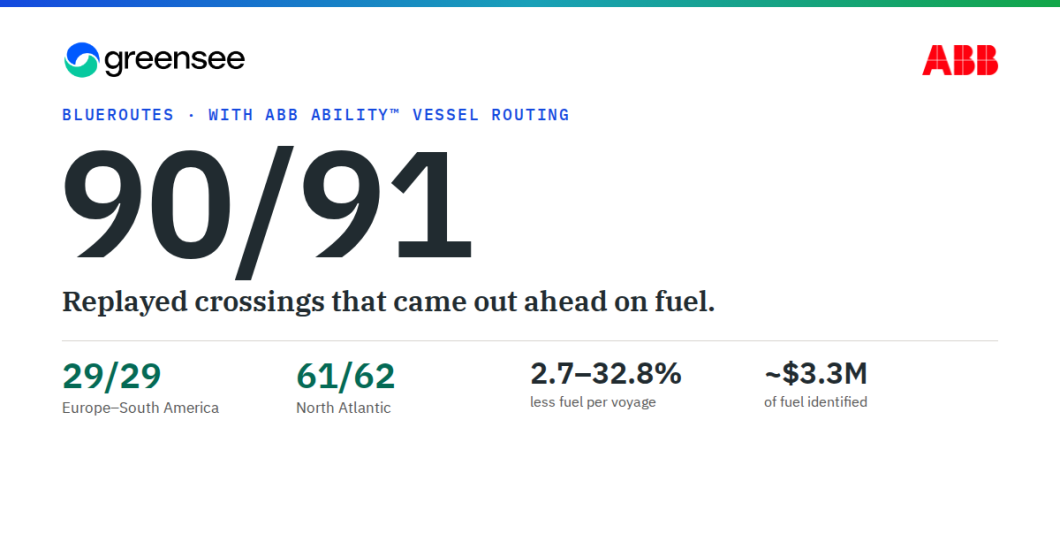
About $3.3M of fuel identified across 91 replayed Atlantic crossings. 90 of them came out ahead, with savings of 2.7% to 32.8% per voyage. Blueroutes by Greensee prices the fuel that keeps reefer cargo cold, and delivers the route through ABB Ability™ Vessel Routing, the engine many bridges already run.
Greensee × ABB — September 2026 · Reefer vessel routing & fuel savings
What we replayed
Two fleets, two very different trades, one method. Every voyage was replayed against the vessel’s actual sailed track from AIS, held to the same schedule, and compared on total ship fuel. Nothing was surveyed, modelled from averages or taken from a vendor brochure. The numbers below are what the ships would have burned had they followed the recommended route instead of the one they sailed.
- 29 crossings, six reefer container vessels, Europe–South America, H1 2026. The original Blueroutes validation: reefer-heavy ships where cargo cooling is a large share of the fuel bill.
- 62 crossings, North Atlantic, 2026. A second operator’s voyages, where severe weather forces captains to choose between sailing south of the storms and holding a direct track.
The results
| Europe–South America | North Atlantic | Combined | |
|---|---|---|---|
| Crossings replayed | 29 | 62 | 91 |
| Crossings that came out ahead | 29 | 61 | 90 |
| Fuel saving per voyage | 3–7% | 2.7–32.8% (10% average) | 2.7–32.8% |
| Fuel identified | $1.8M over six months | ~$1.47M (2,443 t at $600/t VLSFO) | ~$3.3M |
| Extra distance sailed | ~1% | Held to the captain’s own corridor |
The one North Atlantic voyage that did not improve was already on an efficient direct track. It is in the count because the method only works if it reports the misses as plainly as the hits.
Sail south or sail short, the saving is still there
Every North Atlantic crossing starts with the same decision. Some captains add distance to route around the storm systems, trading fuel for safety. Others hold the direct track and accept the weather penalty. A routing engine that only “wins” by overruling that decision is not one a fleet manager can trust.
So the 62-voyage replay was constrained. Where the captain sailed south, a mandatory waypoint near the Azores forced every alternative route through the same southern corridor. What was measured is optimisation within the captain’s own strategy, not credit for a north–south call the captain never considered.
The saving held up on both sides. Longer, weather-avoidance voyages averaged 8.1% less fuel. Shorter, direct voyages averaged 11.8%. At the extremes, an already-short 4,702 km voyage still gave up 2.7%, and a 6,815 km weather-avoidance voyage gave up 32.8%, 160 tonnes of fuel on a single crossing.
Why reefer-aware routing finds fuel that weather routing cannot
Around 20% of a reefer ship’s fuel goes into refrigeration rather than propulsion (Sustainable-Ships, 2026). Conventional weather routing optimises the hull against wind, waves and current, and treats that 20% as fixed. It is not. Ambient temperature, humidity and solar load along the route change how hard the reefers work, and slow steaming makes the trade-off sharper: less fuel through the hull, more through the cooling plant.
Blueroutes scores 30 or more candidate routes per crossing on total ship energy, propulsion plus reefers, using a model trained on more than a billion reefer IoT records. On the 29-crossing reefer service, that produced 34% more fuel saving than weather routing achieved alone. It is the reason the numbers above are additive to the routing a fleet already pays for, not a replacement for it.
How it reaches the bridge
Blueroutes is delivered through ABB Ability™ Vessel Routing. The reefer-aware route arrives as one new waypoint a day inside the ABB service the ship already uses. No new hardware, no retraining, and it works with any reefer brand. For a fleet already running ABB routing, switching on the reefer layer is a configuration decision rather than a project.
What it means for a fleet P&L
Across the 62 North Atlantic voyages alone, the replay identified 2,443 tonnes of fuel out of 25,143 tonnes burned, roughly $1.47M at an indicative $600 per tonne of VLSFO, and about 7,600 tonnes of CO₂ that would not have been emitted. Add the $1.8M identified on the six-vessel reefer service and the two replays point to about $3.3M of fuel across 91 crossings, before any carbon cost under EU ETS is counted.
For a CFO, the point is not the headline. It is that every figure here was produced the same way a lender or auditor would want it: measured against the ship’s own track, held to the ship’s own schedule, and reported voyage by voyage including the one that did not improve.
Get a free demo
Send us vessel names or IMO numbers and we will replay your own voyages. You will see the number in dollars and tonnes, voyage by voyage, including the break-even reefer count below which rerouting is not worth doing. If the savings are there, you will see them. If they are not, you will know that too.
Get a free demo → contact@greensee.ai
Sources: Greensee replay against AIS tracks, 29 Europe–South America crossings (H1 2026) and 62 North Atlantic crossings (2026); Sustainable-Ships (2026). Fuel priced at an indicative $600 per tonne; CO₂ at the IMO factor of 3.114 t per tonne of fuel. Results are counterfactual replays and are reported as fuel identified, not fuel saved.