
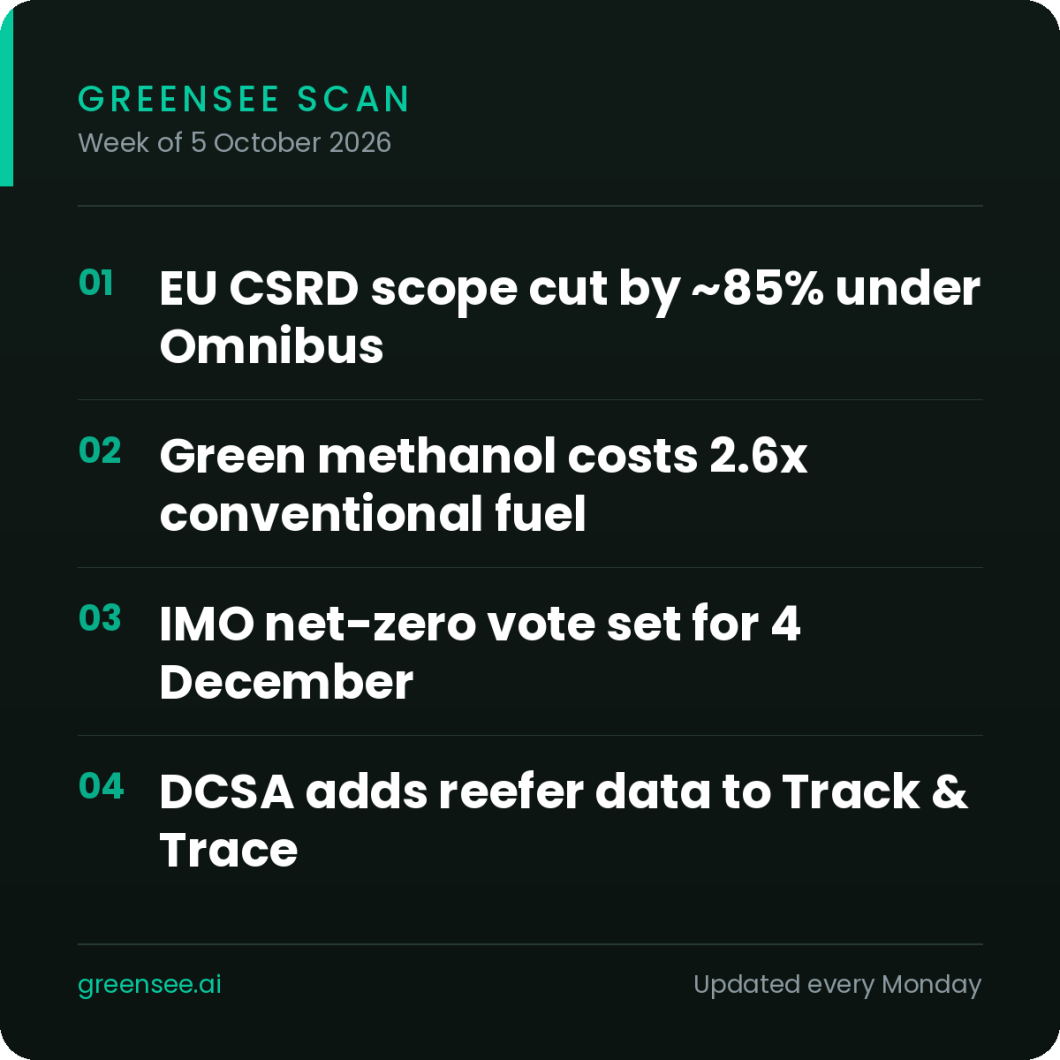
What moved in logistics decarbonisation this week
Logistics Decarbonisation
AI takes action while people remain at the centre of logistics, finds DHL Logistics Trend Radar
DHL’s Logistics Trend Radar 8.0 (24 September) reports AI moving from assistance to autonomous action across supply chains, with agentic AI and analytics enabling real-time decisions. Decarbonisation, sustainable fuels and vehicle electrification are listed as continuing long-term business priorities.
Kuehne+Nagel expands technology footprint with new Chennai Tech Centre
Kuehne+Nagel has opened a Tech Centre in Chennai, India, expected to employ around 250 technology specialists by early 2027 to build digital logistics products such as SALOG, responding to demand for shipment visibility and resilient supply chains. No emissions metrics were disclosed.
AI has reached forwarders’ P&L, now the arguments begin
Kuehne+Nagel projects CHF 150 million in savings from AI by 2027, and C.H. Robinson reports 60% productivity gains since 2022. Industry leaders are split on whether the future lies in clusters of specialised agents or a few ‘super agents’ with broader context.
Cold Chain & Reefer
DCSA expands Track & Trace standard to IoT and reefer containers
On 2 October the Digital Container Shipping Association released Track & Trace 3.0.0, adding IoT data (geolocation, door status) and reefer events (temperature, power status) to its container visibility standard. It is available to DCSA members first and becomes public in the second half of 2027.
Carrier to showcase connected cold chain solutions at Fruit Attraction 2026
Carrier will present its connected cold chain portfolio at Fruit Attraction in Madrid (6–8 October): TempTale GEO APX real-time monitoring, OptimaLINE container refrigeration with EverFRESH technology and the [R]eCool electric trailer unit. The pitch is loss prevention for fresh produce suppliers.
Cold chain expansion fuels Mexico refrigerated transport market
A market report projects Mexico’s refrigerated transport market growing from USD 375.87 million in 2025 to USD 545.25 million by 2034, a 4.22% CAGR, driven by food, pharmaceutical and cross-border trade demand.
Carbon Accounting & Regulation
Korea weighs exempting low-carbon industries from Scope 3 disclosure
South Korea’s Financial Services Commission is reviewing a plan to exempt low-carbon industries from Scope 3 disclosure, with mandatory reporting starting in 2028, three years later than previously planned. The government aims to publish emissions calculation guidelines for 15 major industries and build 1,000 life cycle inventory datasets by 2028.
Verra launches Scope 3 Standard Program
On 15 September Verra launched Version 1.0 of its Scope 3 Standard Program, a framework to quantify and verify emission reductions from value-chain projects, with two initial methodologies. Phase 1 allows project pipeline listings; validation and certification follow in later releases.
Simplification in action: EU CSRD and CSDDD after Omnibus I
Omnibus I cuts in-scope entities by roughly 85%: only undertakings with turnover above EUR 450 million and more than 1,000 employees report from 1 January 2027, with mandatory data points down about 60%. CSDDD transposition moves to 26 July 2028, with full compliance by 26 July 2029.
Sustainable Shipping & Freight
Path to net zero: shipping companies face slow low-carbon bunker transition
Major shipping companies have reduced emissions intensity but increased total greenhouse gas output. Sustainable methanol costs USD 48.69/GJ against USD 18.66/GJ for conventional fuel, and cargo owners’ willingness to pay a premium for greener shipping fell to 3% in 2025 from 4.5% a year earlier.
The Week in Alt Fuels: from promises to timelines
Published 18 September: China’s Shenghang Yongle is the first operational ammonia bunker vessel, with Rotterdam and Pilbara targeting 2026, Singapore Q4 2027 and Hamburg 2029. Recent industrial ammonia accidents in Iraq, Jordan and Tamil Nadu underline the safety case that must be won as volumes scale.
MEPC84: support for Net Zero Framework stabilises ahead of key decision point in late 2026
MEPC 84 concluded in London on 1 May 2026 with renewed support for the IMO Net-Zero Framework and a decisive vote set for 4 December 2026. The committee also approved a new North-East Atlantic Emission Control Area and NOx Technical Code amendments for ammonia-fuelled vessels.